
Quiet Eye training is a performance skill used by elite athletes to improve focus, accuracy, and decision-making under pressure. It teaches you how to control your visual attention so your mind and body stay calm, clear, and connected in high-stress moments.
The Quiet Eye refers to the final, steady visual fixation on a relevant target before and during movement. When this visual focus is stable, the nervous system stays regulated. When it’s rushed or scattered, performance breaks down.
Athletes who struggle with nerves, hesitation, or inconsistency often have an untrained visual system. Their eyes jump too quickly, their attention drifts, and their mind gets pulled into outcomes, mistakes, or distractions. Quiet Eye training retrains your focus so performance becomes automatic instead of forced.
What Quiet Eye Training Develops
• Stronger focus in high-pressure moments
• Faster, clearer decision-making
• Improved accuracy and timing
• Reduced overthinking and hesitation
• Better emotional and nervous system regulation
How It Works
Through guided drills and sport-specific applications, you learn how to:
• Lock visual attention on the right target at the right time
• Slow the mind by stabilizing visual focus
• Stay present before, during, and after execution
• Maintain flow even when pressure increases
Quiet Eye training is not about staring longer or trying harder. It’s about training your attention to stay calm, precise, and intentional when it matters most.
The next time you do find yourself standing over a putt, here’s a tip based on a Quiet Eye study from Sam Vine, Lee Moore, and Mark Wilson in 2011:
1. Assume your stance and align the club so that your gaze is on the back of the ball.
2. After setting up over the ball, fix your gaze on the hole. Fixations toward the hole should be made no more than 3 times.
3. The final fixation should be a Quiet Eye on the back of the ball. The onset of the Quiet Eye should occur before the stroke begins and last for 2 to 3 seconds.
4. No gaze should be directed to the clubhead during the backswing or foreswing.
5. The Quiet Eye should remain on the green for 200 to 300 ms after the club contacts the ball.
After following this protocol in the laboratory, expert putters not only performed better putting in the lab. They took the lessons from this training and saw improvements on the course, improving the amount of holed putts within 10 feet by 5 percent over the course of the next 11 rounds!
“The findings suggest that QE training may provide a useful psychological technique,” the researchers wrote, “as part of a pre-performance routine, to aid performance under pressure and improve performance in competitive environments.”
There are many other examples like this. One of the most convincing recently was work by Daniel Laby, a sports vision researcher in New York, who used eye-tracking goggles with NBA players for free-throw shooting. The heat maps below show where their gaze was focused, and you can see the differences for yourself:
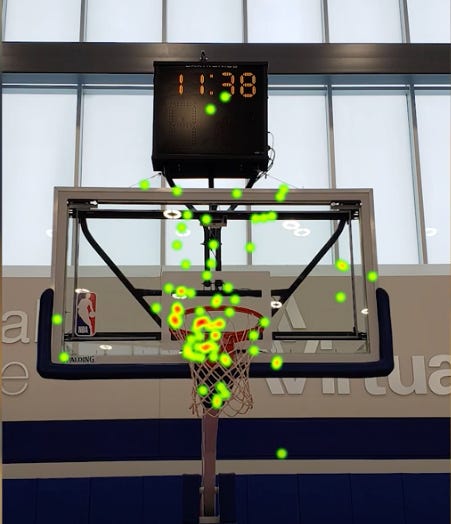
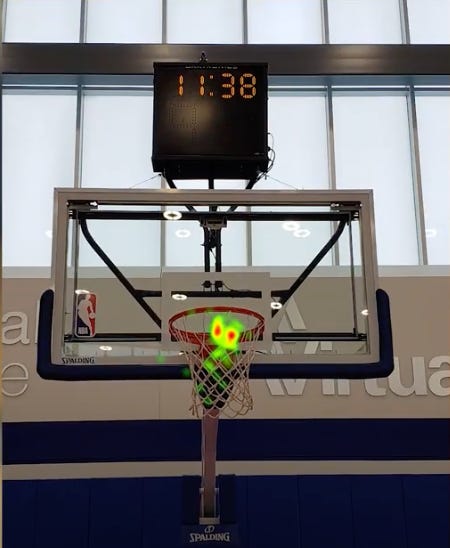
The shooter on the left got 17/30 shots in the basket. The shooter on the right got 30/30 after using the Quiet Eye Technique.
Confidence is often treated as a mindset problem, but it is deeply connected to nervous system state. When the visual system is calm, the nervous system interprets the situation as manageable. This allows confidence to emerge naturally instead of being forced through positive self-talk.
Quiet Eye training helps athletes regulate arousal levels. It prevents the spike into panic or the drop into disengagement. As a result, athletes feel more grounded, present, and in control of their performance.
This regulation is critical for accessing flow state consistently, especially in high-stakes or fast-paced sports.


